

Payroll & Compliance Management in India: 2026 HR Guide
Payroll compliance in India is no longer just a monthly salary-processing activity. In 2026, it has become a strategic HR, finance, and legal responsibility for every growing business.
With India’s labour law and framework moving toward consolidated labour codes covering wages, social security, industrial relations, and occupational safety, employers must review how they structure salaries, process exits, maintain records, and manage statutory contributions.
What Is Payroll Compliance in India?
Payroll compliance refers to the process of paying employees accurately while following all applicable labour laws, tax rules, and statutory obligations. It includes salary calculation, Provident Fund, ESIC, Professional Tax, Labour Welfare Fund, TDS, gratuity, bonus, leave encashment, payslips, registers, and timely filings.
However, payroll compliance is not limited to salary disbursement. It also includes maintaining employee records, updating wage structures, tracking state-specific regulations, and ensuring that every employee category is handled correctly.
Why Payroll Compliance Matters More in 2026
In the past, many businesses treated payroll as a back-office function. However, the compliance environment has changed significantly. Employers now need stronger systems because salary structures, exit settlements, contractual employment, and social security obligations are under closer scrutiny.
Moreover, businesses operating across multiple Indian states must manage different rules for minimum wages, Professional Tax, Labour Welfare Fund, shops and establishment requirements, and statutory registers. Therefore, even a small payroll error can lead to penalties, employee dissatisfaction, or legal notices.
Key Payroll Compliance Changes Indian Employers Should Track
1. Salary Structure and the 50% Wage Rule
One of the most important changes under the Code on Wages, 2019 is the broader definition of wages. wage-code framework is the broader definition of wages. Traditionally, many employers kept basic salary low and increased allowances such as HRA, conveyance, and special allowance. This helped reduce statutory contributions linked to basic wages.
However, under the new wage definition, exclusions from wages are generally capped. If allowances exceed the permitted threshold, the excess may be added back for statutory calculations. As a result, companies may need to review and restructure salary components carefully.
| Area | Possible Impact |
|---|---|
| Provident Fund | Employer contribution may increase if the wage base increases. |
| Gratuity | Future gratuity liability may rise due to revised wage calculations. |
| CTC Planning | Salary structures may need legal and payroll review. |
| Payroll Systems | Automated wage validation becomes more important. |
2. Faster Full and Final Settlement
Full and final settlement has traditionally taken 30 to 45 days in many organizations. However, under the updated wage framework, employers must be ready to settle dues much faster after an employee exits.
This means HR, payroll, finance, IT, and reporting managers can no longer work in isolation. Instead, companies need a connected exit process that calculates earned wages, leave encashment, deductions, reimbursements, bonuses, and tax liabilities quickly.
3. Social Security for Fixed-Term and Flexible Workers
The workforce is changing. Today, many companies rely on fixed-term employees, contractual staff, gig workers, field teams, and project-based workers. Consequently, payroll teams must understand how social security obligations apply to different categories of workers under the Code on Social Security, 2020.
Therefore, businesses should not treat contractual or flexible workers as a low-compliance category.
4. State-Level Payroll Compliance
India’s payroll compliance framework is not only central. Each state may have its own requirements for Professional Tax, Labour Welfare Fund, minimum wages, shops and establishment rules, holidays, and registers.
For example, a company with offices in Mumbai, Bengaluru, Delhi, Pune, Hyderabad, and Chennai may need to follow different state-level payroll rules at the same time. Because of this, multi-state businesses need a structured payroll compliance calendar and updated statutory tracking.
Old Payroll Framework vs 2026 Compliance Expectations
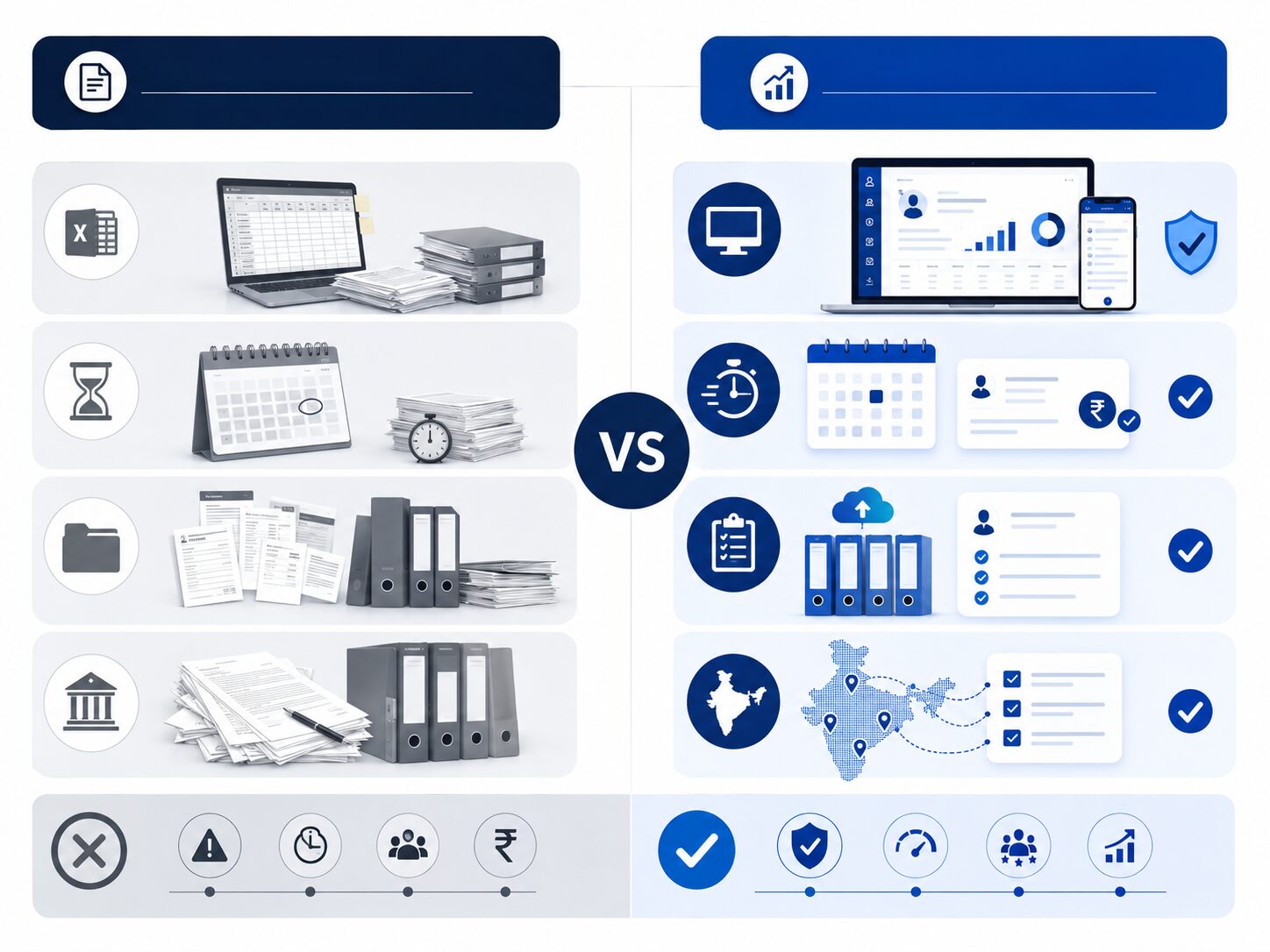
| Payroll Area | Earlier Practice | 2026 Compliance Expectation |
|---|---|---|
| Salary structure | Basic salary often kept low. | Wage structure must be reviewed carefully. |
| F&F settlement | Often completed in 30 to 45 days. | Faster settlement process required. |
| Contract workforce | Often handled separately. | Stronger social security mapping needed. |
| Statutory records | Manual registers and spreadsheets. | Digital, auditable records preferred. |
| Multi-state compliance | Often handled location-wise. | Centralized compliance monitoring required. |
Common Payroll Compliance Risks for Indian Businesses
Many companies do not face compliance problems because of intention. Instead, they face problems because of outdated systems and fragmented processes.
Common risks include incorrect PF calculation, missed ESIC registration, delayed challan payments, wrong Professional Tax deductions, outdated minimum wage rates, incomplete employee records, delayed F&F settlement, and non-standard salary structures.
In addition, businesses using multiple vendors across different states may struggle to maintain one reliable compliance view. As a result, management may not discover gaps until an audit, inspection, or employee dispute occurs.
Payroll errors often become visible only during audits or employee disputes.
IPS Group helps businesses identify compliance gaps early and manage payroll with confidence.
Talk to a Compliance ExpertHow Payroll Outsourcing Helps Reduce Compliance Risk
Payroll outsourcing allows businesses to manage payroll, statutory compliance, and employee lifecycle processes through specialized experts and technology.
More importantly, a professional payroll and compliance management services provider helps businesses stay updated with changing rules, maintain accurate records, and reduce dependency on manual calculations.
| Benefit | How It Helps |
|---|---|
| Automated payroll processing | Reduces salary and deduction errors. |
| Compliance calendar tracking | Helps avoid missed statutory deadlines. |
| Salary structure review | Supports wage-code readiness. |
| F&F automation | Speeds up exit settlement. |
| Pan-India compliance | Manages PF, ESIC, PT, LWF, and state rules. |
| Audit-ready documentation | Improves transparency and control. |
Why Choose IPS Group for Payroll & Compliance Management?
Integrated Personnel Services Limited, known as IPS Group, brings over 21 years of experience in workforce, payroll, and statutory compliance management. As a publicly listed company on the National Stock Exchange, IPS Group supports businesses with scalable payroll operations, compliance monitoring, and workforce management solutions across India.
With experience managing thousands of associates across multiple locations, IPS Group helps companies move from reactive payroll processing to proactive compliance management.
Therefore, if your business wants to reduce payroll risk, improve statutory accuracy, and prepare for 2026 compliance expectations, IPS Group can act as your strategic payroll compliance partner.
Payroll Compliance FAQs
What is payroll compliance in India?
Payroll compliance in India means calculating and processing employee salaries according to applicable labour laws, tax rules, and statutory requirements. It includes PF, ESIC, Professional Tax, Labour Welfare Fund, TDS, gratuity, bonus, payslips, registers, filings, and full and final settlement.
Why is payroll compliance important for Indian businesses?
Payroll compliance is important because incorrect salary calculations, missed statutory payments, delayed filings, or incomplete records can lead to penalties, employee disputes, legal notices, and audit risks. In addition, accurate payroll builds employee trust and improves business credibility.
What are the major payroll compliance areas in India?
The major payroll compliance areas include salary structure, minimum wages, Provident Fund, ESIC, Professional Tax, Labour Welfare Fund, TDS, gratuity, bonus, leave encashment, statutory registers, payslips, and full and final settlement.
How does the wage-code framework affect payroll compliance?
The wage-code framework affects payroll compliance by changing how wages are defined and how salary components are considered for statutory calculations. As a result, employers may need to review basic salary, allowances, PF contributions, gratuity liability, and overall CTC structures.
Why should companies outsource payroll compliance?
Companies outsource payroll compliance to reduce errors, manage statutory deadlines, stay updated with changing laws, handle multi-state compliance, automate payroll processing, and maintain audit-ready records.
Final Thoughts
Payroll compliance in India is becoming more complex, more time-sensitive, and more technology-driven. As labour regulations evolve, businesses must review salary structures, strengthen exit processes, update statutory records, and monitor state-wise compliance more carefully.
Ultimately, companies that invest in structured payroll and compliance management will be better prepared for audits, employee expectations, and future regulatory changes.
Stay ready for India’s changing payroll compliance requirements.
Partner with IPS Group for accurate payroll processing, statutory compliance management, and pan-India workforce support.
Schedule a Payroll Compliance Audit
Recent Comments